Vector Industrial and City Buildings: A Versatile Resource for Creative Designers
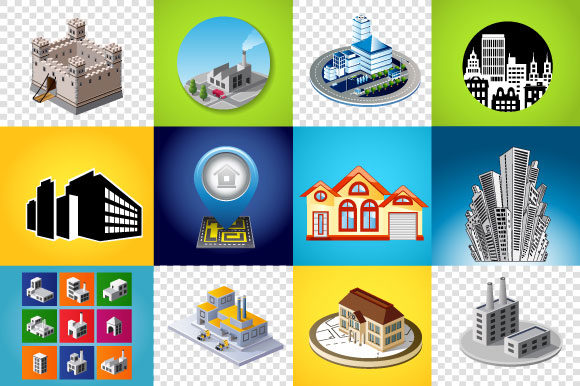
Vector Industrial and City Buildings is a comprehensive set of scalable graphic elements that provide creative designers with the tools needed to bring urban and industrial scenes to life. Whether you're designing for print, digital media, or presentations, these vector files offer flexibility, adaptability, and high-quality visuals that can be easily customized to suit a wide range of projects.
These assets include a variety of industrial and city building types, each available in multiple sizes and formats. This makes them ideal for use in different contexts, from background illustrations to detailed architectural renderings. The ability to edit colors directly within the supplied files ensures that designers can match their brand identity or project requirements without needing to start from scratch.
Understanding the Value of Vector Files
One of the key advantages of using vector files for design projects is their scalability. Unlike raster images, which can lose quality when resized, vector graphics maintain sharpness and clarity at any size. This makes them particularly useful for both print and web applications, where resolution and detail are critical.
The Vector Industrial and City Buildings set includes several file formats such as .ai, .eps, .jpg, .png, and .psd. Each format serves a specific purpose, allowing designers to choose the most suitable one based on their workflow and output needs. For example, .ai and .eps files are perfect for editing in Adobe Illustrator, while .psd files allow for advanced layer-based work in Photoshop.
Common Challenges and How Vector Industrial and City Buildings Can Help
Creative professionals often face challenges when sourcing high-quality, editable graphics for their projects. Stock image websites may not always provide the right level of customization, and creating original vector assets from scratch can be time-consuming and resource-intensive.
With Vector Industrial and City Buildings, designers can overcome these challenges by having access to pre-designed, editable elements that can be quickly integrated into their workflows. The set’s diverse selection of buildings allows for greater creative freedom, enabling users to build complex scenes without needing to create every element individually.
Another common issue is ensuring consistency across different media formats. Whether designing for a website, brochure, or social media campaign, maintaining visual coherence is essential. The included .jpg and .png files make it easy to export and use these assets across various platforms without compromising quality.
Practical Applications and Outcomes
The versatility of Vector Industrial and City Buildings makes them applicable to a wide range of industries and design disciplines. Urban planners and architects can use these assets to create visual representations of cityscapes or industrial zones. Graphic designers working on branding materials might incorporate these elements into logos, packaging, or marketing collateral.
For web developers and UI/UX designers, these vector assets can be used to enhance the visual appeal of websites, dashboards, or interactive maps. The ability to adjust colors and scale the elements ensures that they can be seamlessly integrated into existing designs without disrupting the overall aesthetic.
Additionally, educators and students in design-related fields can benefit from using these resources as part of their learning process. They provide an excellent opportunity to practice working with vector software, experimenting with color theory, and understanding how to compose complex scenes using individual elements.
How Different Users May Approach the Topic
Depending on their experience and goals, different users may approach Vector Industrial and City Buildings in unique ways. A beginner designer might use the set as a starting point for learning how to manipulate vector graphics, while an experienced professional could leverage the assets to streamline their workflow and reduce production time.
Some designers may prefer to modify the provided elements extensively, adjusting colors, adding textures, or combining them with other assets to create entirely new compositions. Others may use the buildings as-is, relying on their pre-designed quality to meet project deadlines efficiently.
No matter the approach, the flexibility of these vector files ensures that they can be adapted to fit a wide range of creative needs. Their availability in multiple formats also allows users to experiment with different design tools and techniques, making them a valuable addition to any designer's toolkit.
Useful Considerations and Recommendations
When working with Vector Industrial and City Buildings, it's important to consider the context in which the assets will be used. For instance, if designing for print, it's crucial to ensure that the resolution and color modes are appropriate for the intended medium. Similarly, when using these elements for digital projects, optimizing file sizes and ensuring compatibility with web standards is essential.
It's also recommended to explore the full range of available formats and take advantage of the different file types to maximize usability. For example, using .psd files allows for more detailed editing in Photoshop, while .eps files are ideal for high-quality printing.
Finally, designers should feel free to experiment with the provided assets, customizing them to reflect their personal style or project requirements. The ability to edit colors and scale elements makes this set highly adaptable, encouraging creativity and innovation in design work.